Best DIY Drone Kits and Builds (2026)
 By @pickwise
These DIY drone kits and builds come from published parts lists and build guides by Oscar Liang, Joshua Bardwell, PX4 and others, priced part by part. Building rarely costs less than buying the same drone built.
Circuit Digest LiteWing ESP32 Drone
The cheapest way to put together a drone you can program. Hackaday put the open-source parts list at about $12 and CNX Software covered the $50 kit, and its firmware comes from the Crazyflie. Hackaday also calls it more of an indoor toy than a DJI rival: no camera, Wi-Fi range of tens of metres, and only 2 left on Tindie, sold without a battery.
- Size / class
- 100 mm PCB-frame micro quad, 1S, brushed motors
- Video
- None (no camera)
- How it's flown
- Phone app over Wi-Fi, line of sight, indoors
- Flight time
- 5 to 7 min on a 1300mAh pack (Circuit Digest)
- Weight
- About 45 g without battery: sub-250 g
- Soldering
- None for the assembled board
- Setup software
- LiteWing app; firmware based on Crazyflie (ESP-IDF)
- Also needs
- 1S LiPo, 20C or higher (not included), and a phone
Oscar Liang's 1S 3-Inch Toothpick (No Solder)
Air65 whoop electronics on a Crux3 frame, and Oscar Liang says everything plugs in, so a first build takes about 30 minutes with no iron. It flies over 5 minutes and weighs 49 g. His catch is durability: fine landing on grass, not on concrete. The frame, motor and prop kit ships from AliExpress and takes weeks to arrive.
- Size / class
- 3-inch 1S toothpick
- Video
- Analog
- How it's flown
- Analog goggles and an ELRS radio
- Flight time
- Over 5 min on a 480mAh pack (Oscar Liang)
- Weight
- 49 g with a 480mAh pack: sub-250 g
- Soldering
- None (plug and play)
- Setup software
- Betaflight (keep BetaFPV's stock firmware)
- Also needs
- ELRS radio, analog goggles, 1S BT2.0 charger
Parts list · 5 parts$141.77
- Flight controller + ESC + receiver + VTXBetaFPV Matrix 1S 5IN1 II, Solder-free versionPick the Solder-free version, with motor plugs$54.99BetaFPV
- Frame + motors + propsHappymodel Crux3 kit: frame, 4x EX1202.5 11500KV, Gemfan 3018 propsChoose 11500KV. AliExpress shows 47% off a $93.98 list price with no end date; no US store sells this kit. Plus $10.54 shipping$49.81AliExpress
- $11.99BetaFPV
- CanopyBetaFPV Air II canopy$2.99BetaFPV
- $21.99BetaFPV
Total$141.77Oscar Liang's Tiny Whoop Build From Scratch
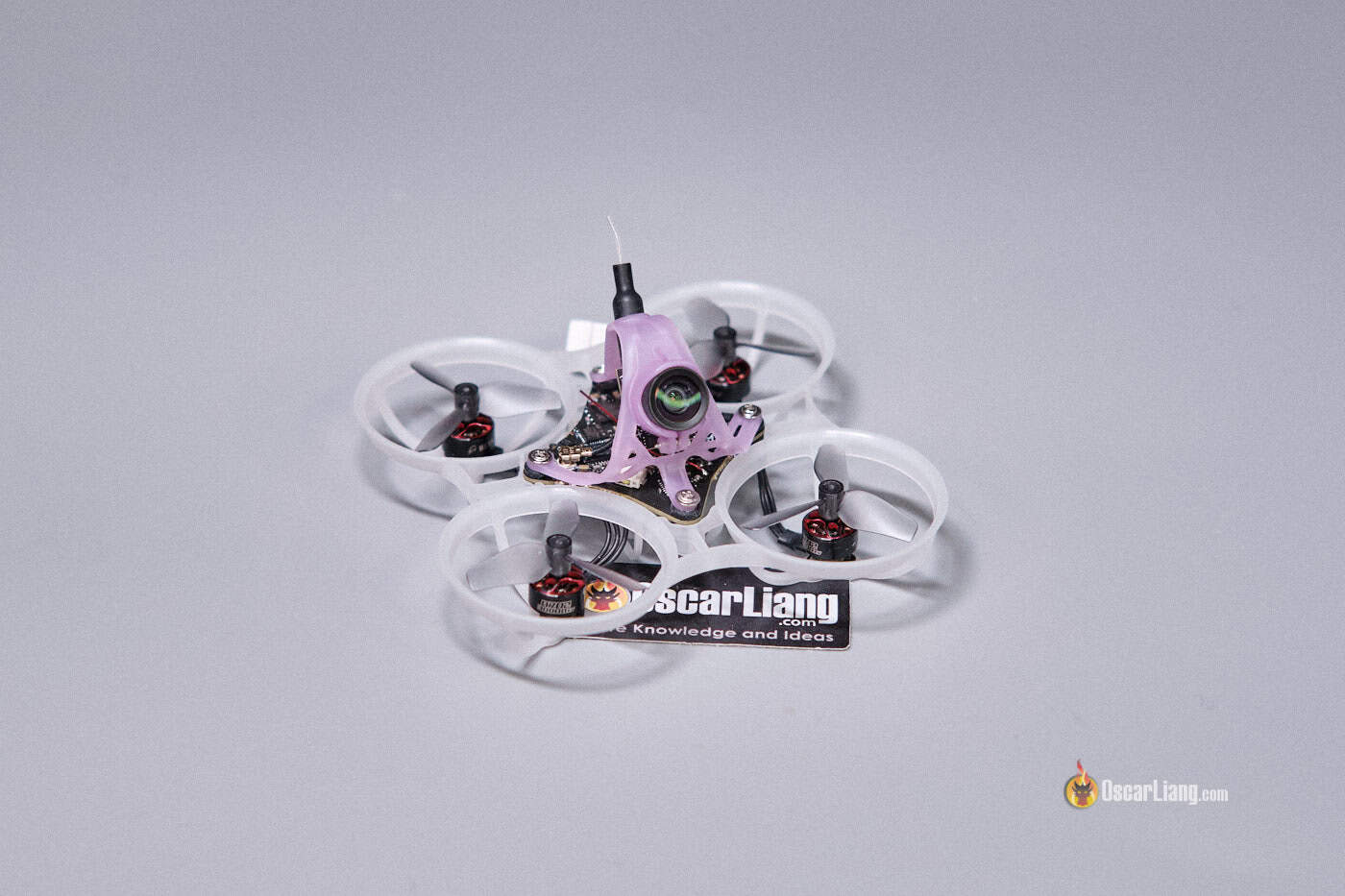
A 16.8 g indoor whoop, and Oscar Liang's guide walks through every pad and setting. With today's solder-free board and plug-in motors it needs no iron. His own catch: building costs more, so just get the Air65. The BetaFPV Air65 II with the same electronics costs $99.99 built, about $26 less than these parts without batteries. quadmath.com gives the same advice.
- Size / class
- 65 mm 1S brushless tiny whoop
- Video
- Analog
- How it's flown
- Analog goggles and an ELRS radio, indoors
- Flight time
- About 3:15 of hard flying on 1S 300mAh (Oscar Liang)
- Weight
- 16.8 g without battery: sub-250 g
- Soldering
- None with the Solder-free board and 2026 motors
- Setup software
- Betaflight, plus Bluejay ESC firmware
- Also needs
- ELRS radio, analog goggles, 1S BT2.0 charger
Parts list · 7 parts$147.93
- Flight controller + ESC + receiver + VTXBetaFPV Matrix 1S 5IN1 II, Solder-free versionReplaces the guide's BetaFPV Air 5-in-1, now out of stock$54.99BetaFPV
- MotorsBetaFPV 0702 Brushless Motors (2026), Racing 30000KV, set of 4Replaces the original 0702 30000KV, out of stock; JST1.25 plugs$39.99BetaFPV
- $11.99BetaFPV
- $5.99NewBeeDrone
- $3.99RaceDayQuads
- $8.99BetaFPV
- $21.99BetaFPV
Total$147.93Bitcraze Crazyflie 2.1+
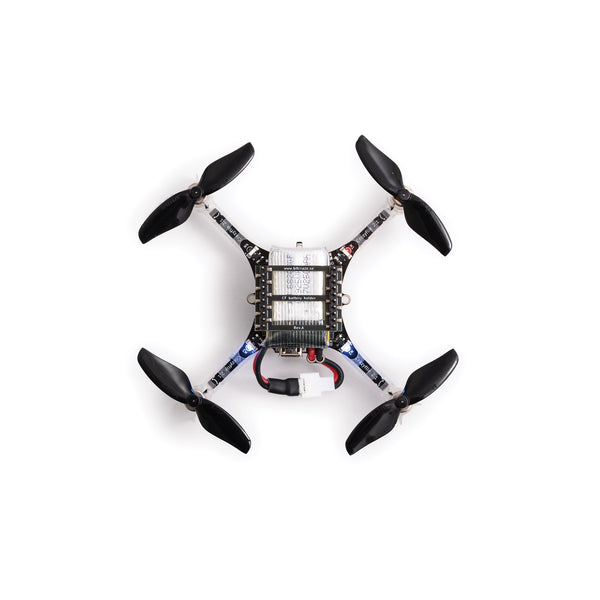
A 29 g programmable nano quad that goes together with screws and plugs in under 10 minutes, then flies from a phone or from Python scripts. In a Leiden University thesis, Ernie Tsie-A-Foeng found assembly easy but got about 5 minutes per charge, and the $55 Flow deck that hover and position hold need drifted over shiny floors.
- Size / class
- 29 g nano quad, 1S, for indoor programming
- Video
- None (no camera)
- How it's flown
- Phone over Bluetooth, or a computer and gamepad
- Flight time
- 7 min on the stock battery (Bitcraze)
- Weight
- 29 g: sub-250 g
- Soldering
- None
- Setup software
- Crazyflie client (cfclient) and the cflib Python library
- Also needs
- Crazyradio 2.0 for computer flight; spare 250mAh packs $6.50
Hawk's Work F450 Drone Kit (Kit A, Pixhawk + GPS)
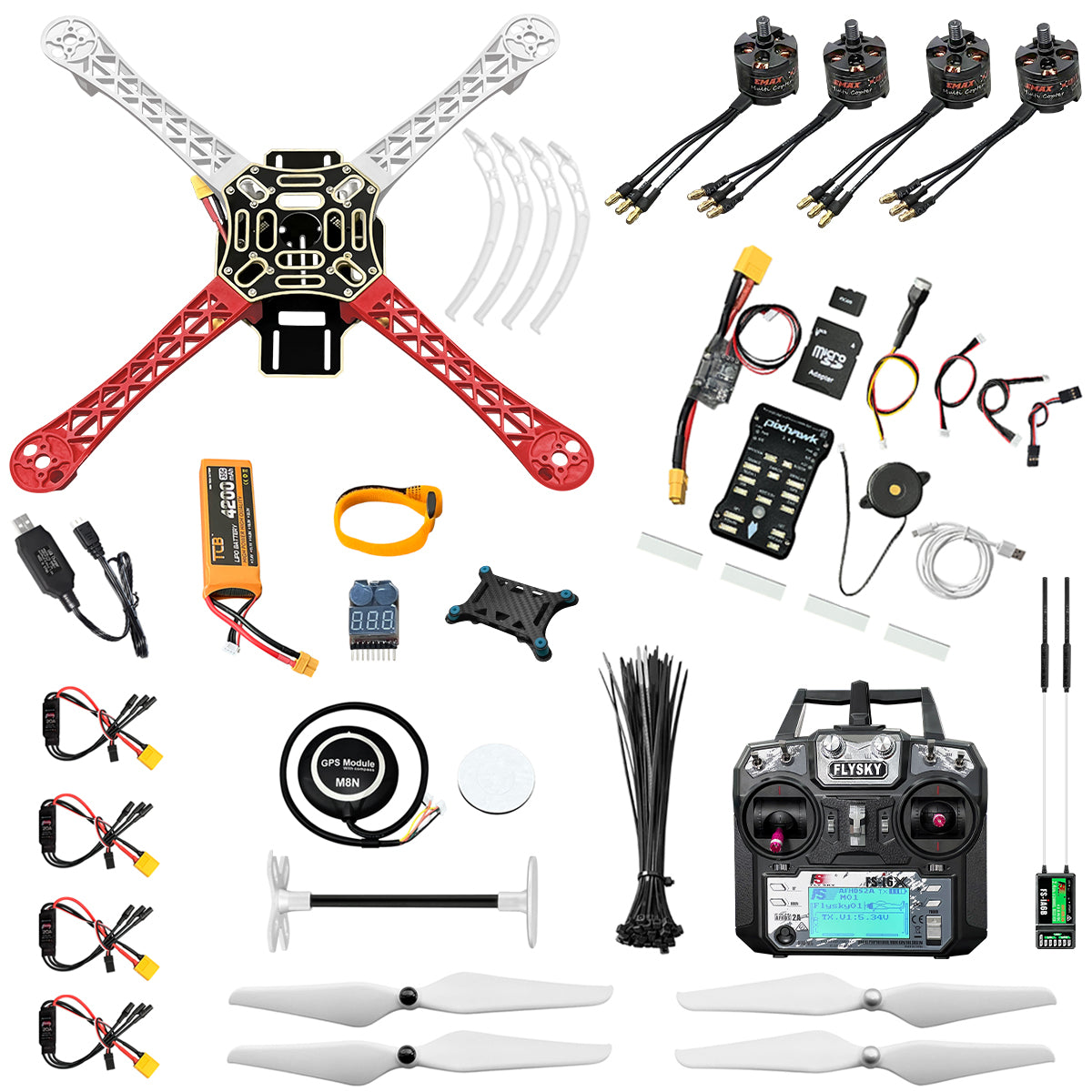
The classic F450 GPS quad in one box: pre-soldered frame, Pixhawk 2.4.8, M8N GPS, battery and FlySky radio, flown line of sight with position hold and return home. ArduPilot's old build page called the F450 the best frame to start with. The catch, from owner Cliff Chafin on ArduPilot's forum: the board shipped on 2019 firmware and setup took days, not hours.
- Size / class
- 450 mm GPS quad, 3S
- Video
- None (FPV can be added later)
- How it's flown
- Line of sight with GPS Loiter and return home
- Flight time
- 10 to 20 min (Hawk's Work)
- Weight
- Max take-off 1.8 kg: needs FAA registration and Remote ID
- Soldering
- None (pre-soldered frame, plug-in leads)
- Setup software
- ArduPilot through Mission Planner
- Also needs
- Remote ID module; radio and USB-charged battery included
Holybro X500 V2 PX4 Development Kit
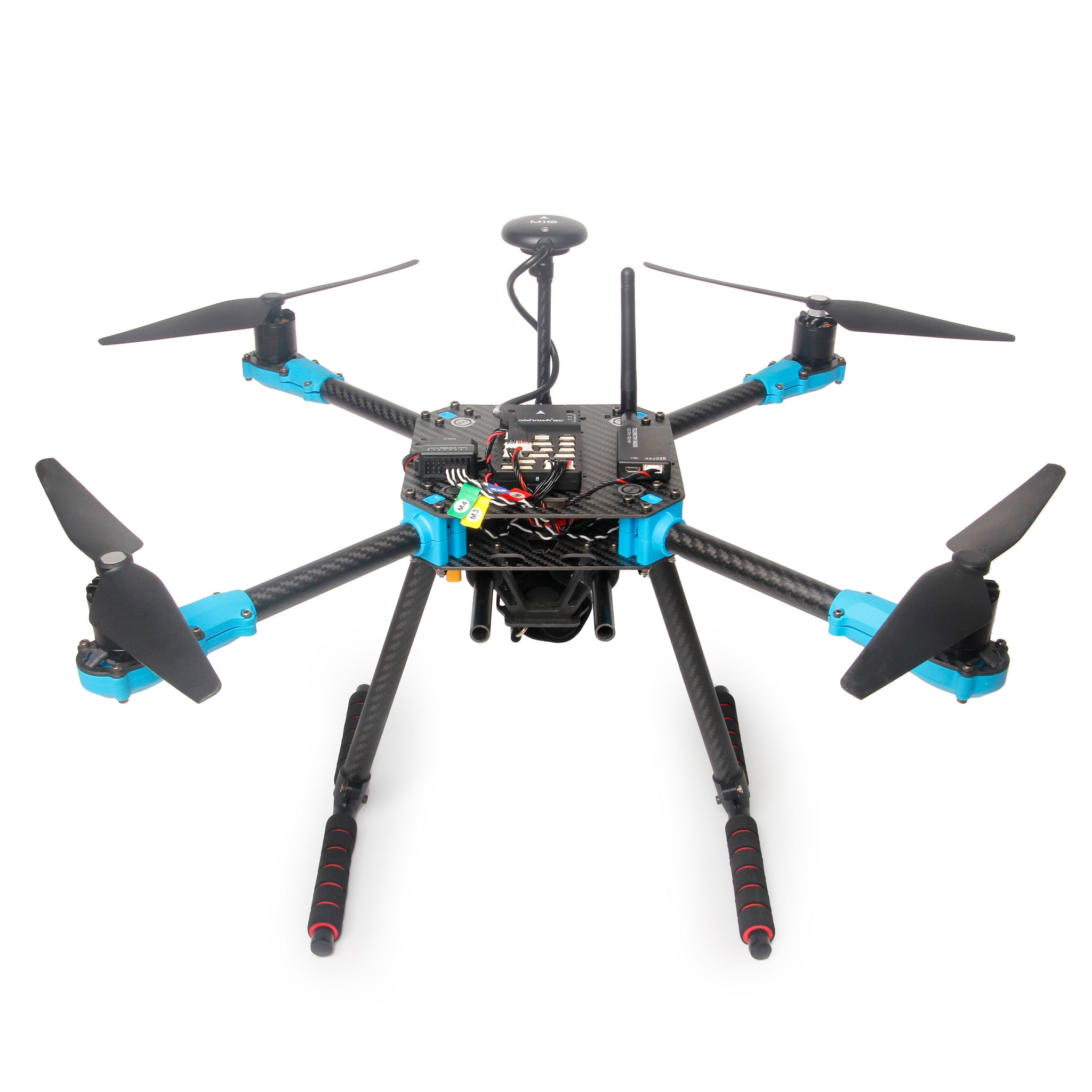
PX4's own guide uses it as the reference GPS quad, and the kit bolts together in about 30 minutes with no soldering. It hovers about 18 minutes and carries a companion computer for autonomy work. Daniel Payne's June 2026 build log and idorobotics both warn of a steep PX4 learning curve, and ELRS needed custom firmware. Skip the Amazon resellers at $1,699.
- Size / class
- X500 V2 carbon frame, 4S, Pixhawk 6C
- Video
- None
- How it's flown
- Line of sight in PX4 Position mode; missions in QGroundControl
- Flight time
- About 18 min hover on 5000mAh (Holybro)
- Weight
- Frame 610 g: needs FAA registration and Remote ID
- Soldering
- None
- Setup software
- PX4 through QGroundControl (also runs ArduPilot)
- Also needs
- Radio and receiver, 4S charger, Remote ID module
Parts list · 2 parts$685.99
- KitHolybro PX4 Development Kit X500 V2, Pixhawk 6C / M10 / 915 MHzMotors and ESCs come installed; battery and radio not included$609Holybro
- $76.99Amazon
Total$685.99Oscar Liang's Budget 5-Inch FPV Build
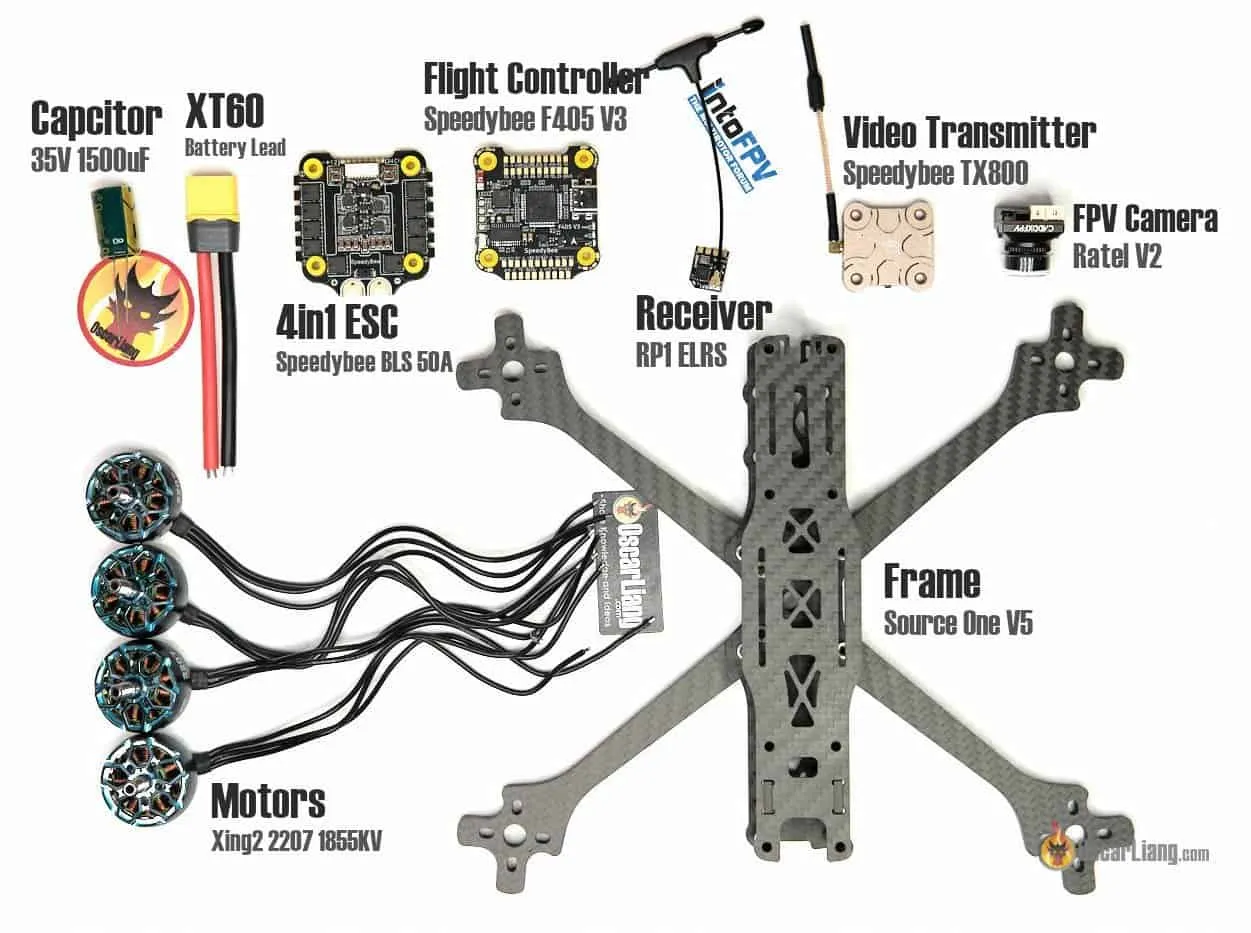
The page that owns cheap FPV build searches, updated in October 2026, with a branded parts list and full build and Betaflight tutorials behind it. A 5-inch flies 5 to 7 minutes. Oscar Liang's own catch: buying the GEPRC Vapor X5 bind-and-fly ($236.99) is cheaper than his parts list, and US stores now lack three of his parts.
- Size / class
- 5-inch 6S freestyle
- Video
- Analog
- How it's flown
- Analog goggles and an ELRS radio
- Flight time
- 5 to 7 min on 6S 1100mAh, 5-inch class (Oscar Liang)
- Weight
- Frame alone 136.5 g (TBS Source One V6); no built weight published
- Soldering
- Yes (XT60, motors, receiver, VTX)
- Setup software
- Betaflight
- Also needs
- ELRS radio, analog goggles, 6S charger, solder kit, Remote ID
Parts list · 9 parts$412.85
- $38.99RaceDayQuads
- $80.99GEPRC
- 4 × $24.99RaceDayQuads
- VTXXILO STAX 5.8GHz VTX, 25-600mW, SmartAudioReplaces the guide's SpeedyBee TX800, out of stock at RDQ and Lumenier$38.99Lumenier
- $12.99RaceDayQuads
- CameraCaddx Ratel 2 analog cameraReplaces the guide's Foxeer Razer Micro, sold only through AliExpress$30.99Caddx
- ReceiverBetaFPV ELRS Nano 2.4GHz receiverReplaces the guide's BAYCK ELRS Nano, linked only as an AliExpress search$11.99RaceDayQuads
- 2 × $42.99Amazon
- 3 × $3.99RaceDayQuads
Total$412.85Joshua Bardwell QAV-S 2 Sub-250 3-Inch Build
Bardwell's video covers every solder joint of a 3-inch quad that stays under 250 g, so no FAA registration. astr0x finished his in about two hours at 229 g, and MattyFleisch and Colibri FPV also back the kit. The catch: the $324.99 kit is back-ordered at GetFPV and sold out at RDQ, and the same parts bought loose cost $50.89 more than the kit would.
- Size / class
- 3-inch 4S freestyle
- Video
- Analog
- How it's flown
- Analog goggles and an ELRS radio
- Flight time
- 4 to 6 min per pack, 3-inch class (Oscar Liang)
- Weight
- 229 g with a Tattu 4S 650mAh: sub-250 g
- Soldering
- Yes (motors, VTX, receiver, battery lead)
- Setup software
- Betaflight, plus AM32 for the ESC
- Also needs
- ELRS radio, analog goggles, 4S charger, soldering kit
Parts list · 9 parts$460.33
- $83.99RaceDayQuads
- Flight controller + ESCLumenier LUX HD G4 AIO with 35A AM32 4-in-1 ESC$116.99RaceDayQuads
- MotorsFlyFishRC Flash 1404 4500KVReplaces the kit's Xilo Stealth 1404 4500KV, out of stock at RDQ and GetFPV4 × $19.99Pyrodrone
- $30.99Caddx
- $38.99Lumenier
- $12.99RaceDayQuads
- 3 × $3.99RaceDayQuads
- $20.49RaceDayQuads
- 4 × $15.99Pyrodrone
Total$460.33Joshua Bardwell QAV-S 2 5-Inch Build (HD Ready Kit)
Bardwell's beginner series films a full 5-inch build step by step, with separate episodes for analog, DJI and Walksnail video. MattyFleisch rates the QAV-S 2 SE kit best for beginners. Bardwell's case for building is that you learn to repair what you will crash. The catch is price: the analog kit is sold out at $441.99, so this is the HD Ready kit plus a Walksnail system.
- Size / class
- 5-inch 6S freestyle
- Video
- Digital (Walksnail Avatar)
- How it's flown
- Walksnail Avatar goggles and an ELRS radio
- Flight time
- 5 to 7 min on 6S 1100mAh, 5-inch class (Oscar Liang)
- Weight
- Frame alone 130 g with HD camera mount; no built weight published
- Soldering
- Yes (full DIY kit)
- Setup software
- Betaflight
- Also needs
- ELRS radio, Walksnail goggles, 6S charger, solder kit, Remote ID
Parts list · 4 parts$655.46
- KitBeginner DIY FPV Drone Kit, QAV-S 2 Joshua Bardwell SE 5", HD ReadyFrame, FC, ESC, motors and props; no video system or receiver$389.99RaceDayQuads
- $159Caddx
- $20.49RaceDayQuads
- 2 × $42.99Amazon
Total$655.46
.png?1745207504)



How to choose
To build your own drone with no soldering, start with Oscar Liang's 1S toothpick, which plugs together in about 30 minutes. For a drone that holds position and flies home on GPS, the Hawk's Work F450 kit comes in one box with its radio. To learn coding, the Crazyflie 2.1+ or the $49 LiteWing fly from a phone. To learn to solder and repair, Joshua Bardwell's sub-250 g 3-inch build has a video for every step.
A DIY drone kit, a drone building kit and a build-your-own drone kit all mean you put it together. A DIY FPV drone adds a camera and goggles, and an FPV drone build usually means soldering.
What the parts lists leave out: the radio, goggles and charger cost about as much as a small quad. An ELRS radio starts at $32.99 (BetaFPV LiteRadio 3) and analog goggles at $159.99 (Eachine EV800D, since the $74.99 BetaFPV VR04 is sold out). Walksnail Goggles L cost $199.99, and a 4S to 6S charger with its power supply $76.98. Anything 250 g or more needs FAA registration and Remote ID (the NewBeeDrone BeeID is $36.99), and every flyer takes the free TRUST test. Most analog video transmitters need a US Technician ham licence. Since December 22, 2025, new foreign-made drone parts, DJI included, can't get FCC approval, so spares may get scarce.
Ordered by how much soldering a build needs, none first, then by its parts total, lowest first. Totals count the batteries each build's spec names, not shared gear or shipping.
Prices checked October 17, 2026.