Best OpenCode Alternatives (2026)
 By @pickwise
The best OpenCode alternatives are the terminal coding agents developers say they moved to in blog posts and Hacker News threads, checked against independent hands-on reviews.
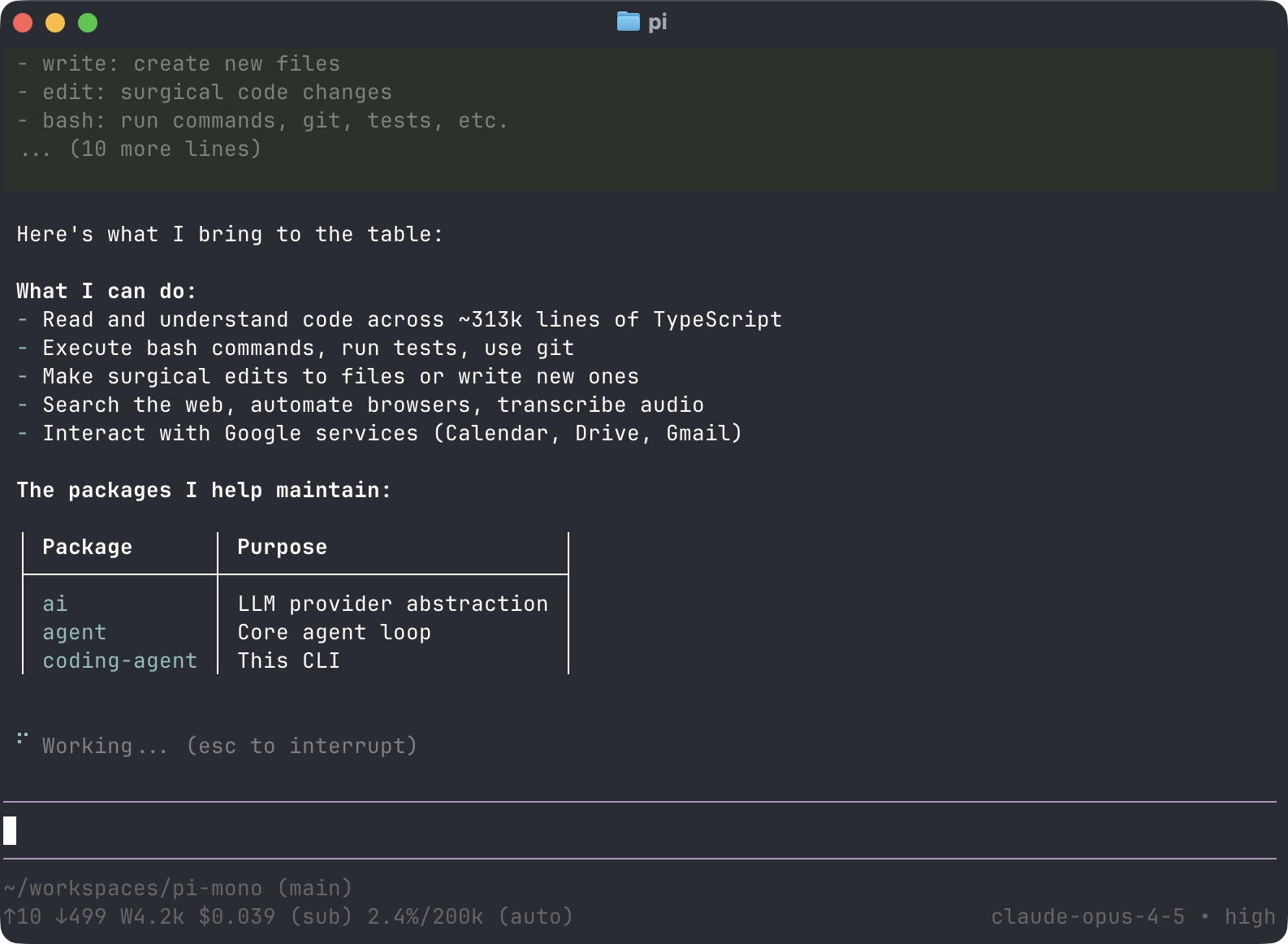
Pi
The agent people name most often when they leave OpenCode. Federico Cervelli swapped an OpenCode config of more than 200 lines for three short files and found he could read Pi's whole system prompt on one screen. It ships without plan mode, sub-agents or permission prompts, and you add what you need as extensions. Cervelli says the first week hurt, and Hacker News user Havoc still misses plan mode.
- Price
- Free; pay your model provider or sign in with a subscription
- Open source
- Yes, MIT
- Models
- 15+ providers, including OpenRouter and local models through Ollama
- Platforms
- macOS, Linux, Windows
- GitHub stars
- 114,394
- Maker
- Earendil Inc.
Claude Code
Felipe Fontoura left for OpenCode in May 2026, built twelve agents on open models, then came back, because a Claude subscription only covers Anthropic's own harness and open models at a similar price were the wrong trade. Pickuma's reviewer calls it the most polished of the terminal agents he ran. It is closed source and runs Claude models only, and Pedro Pinho notes its Bash sandbox is off until you turn it on.
Codex CLI
Pedro Pinho at Alongside makes it the default pick for most teams because it is safe before you configure anything: writes are limited to the workspace, network access is off and an operating-system sandbox enforces both. The client is Apache-2.0 and accepts custom model providers, but it is built for OpenAI models on a ChatGPT plan, and Plus is the lowest tier whose listing includes the CLI.
oh-my-pi
A fork of Pi with the missing pieces already built in: sub-agents, language-server and debugger tools, and more than 60 providers. Jonathan Reis moved to it from Claude Code, Cursor and OpenCode for that reason, and several Hacker News users rank it above both Pi and OpenCode. The catch is the reverse of Pi's. One commenter mocks its long system prompt, and another still found it unpolished.
- Price
- Free; pay your model provider
- Open source
- Yes, MIT
- Models
- 60+ providers
- Platforms
- macOS, Linux, Windows (native, no WSL)
- GitHub stars
- 35,109
- Maker
- Stencil Labs; a fork of Pi
Crush
Charm builds terminal interface libraries that thousands of other apps use, and it shows here. Joe Rice-Jones at XDA says Crush pulled in his Claude Code config and shows the API cost of each step in the sidebar. It is a single Go program that switches models mid-session. Two catches: you can't sign in with a Claude, ChatGPT or Gemini subscription, and the FSL license bars competing products until each release turns MIT after two years.
goose
The pick when you don't want one company in charge: goose is Apache-2.0, started at Block and now sits with the Agentic AI Foundation at the Linux Foundation. It has a CLI and a desktop app and can use a Claude, ChatGPT or Gemini subscription. Attila Macskásy got about 2,400 lines of correct code from it on a local model, then watched it loop for two hours on a vaguer task. By default it acts without asking.
Antigravity CLI
Google's replacement for Gemini CLI, run as agy. Jessica Wachtel at The New Stack found it could edit files and run tests in scripted mode where Gemini CLI could not, and Sumit Patel uses it daily for small changes in existing code but got a poor result building from scratch. Unlike Gemini CLI it is closed source, and the free allowance is a weekly quota that reviewers report running out quickly.
Aider
The oldest project here and the easiest to undo: every edit becomes a git commit you can revert. When kenimo49 ran the same twelve tasks through three agents on a local Qwen model, Aider finished all twelve with the smallest prompt, ahead of OpenCode and Qwen Code. The catch is upkeep. The repository has had no commits since May 22, 2026, and comparisons note it documents no MCP support.
- Price
- Free; pay your model provider or run local models
- Open source
- Yes, Apache-2.0
- Models
- Almost any LLM, including local models
- Platforms
- macOS, Linux, Windows
- GitHub stars
- 49,478
- Maker
- Aider AI
GitHub Copilot CLI
Worth a look if you or your employer already pay for GitHub Copilot, because the CLI is included in every plan, the free one too. Hacker News user gwerbin describes it as a lot like OpenCode but stripped down, and one subscription reaches both Claude and GPT models. Quibblingeek, who moved from OpenCode to oh-my-pi, finds it more limiting. Usage draws on monthly AI credits, and the client is not open source.
Qwen Code
Qwen's team started from Gemini CLI and has developed it independently since, adding sub-agents, approval modes and support for OpenAI, Anthropic and Gemini style APIs. It suits people who run Qwen models. In kenimo49's local test it finished 10 of 12 tasks and took 45 minutes to set up, with a first prompt of about 19,400 tokens. Older guides promise 1,000 free requests a day, but that free tier ended on April 15, 2026.
- Price
- Free; pay a model provider or an Alibaba Cloud Coding Plan
- Open source
- Yes, Apache-2.0
- Models
- OpenAI, Anthropic, Gemini and Qwen APIs; local via Ollama or vLLM
- Platforms
- Linux, macOS, Windows
- GitHub stars
- 28,434
- Maker
- Qwen (Alibaba Cloud)

How to choose
If OpenCode feels bloated, get Pi, or oh-my-pi if you want Pi with the tools already built in. If you want one vendor's best models at a flat monthly price, get Claude Code or Codex CLI. Codex is the one that sandboxes commands by default. If you want open source with any model and no single company in charge, get Goose. If you want the nicest terminal interface, get Crush. If you already pay for GitHub Copilot, its CLI is included.
A few things the makers' pages won't tell you. OpenCode 2 has a new plugin API, so OpenCode 1 plugins don't run on it, and that is a reason recent switchers give on Hacker News. Crush grew out of an older Go project that was also called OpenCode, and its license is source-available, not open source. Gemini CLI stopped serving personal accounts on June 18, 2026, and Antigravity CLI replaced it. Aider has had no commits since May 22, 2026. Kilo CLI is built on OpenCode, so switching to it changes little. A free agent still needs a model: you pay a provider per token or run one on your own hardware.
The list is ordered by how many independent developers and reviewers recommend each agent, then by GitHub stars, then by price.
Prices checked October 11, 2026.
More guides like this
Claude Code Plugins (2026): What Developers Install
The best Claude Code plugins, picked from the setups developers publish after pruning their own installs and from Hacker News threads where people say what they kept, not from install counts alone. A plugin is a bundle. One install can carry skills, slash commands, subagents, hooks and MCP servers. A skill is a single instruction file Claude loads when it judges it relevant, and an MCP server is a connection to an outside tool, so a plugin can contain both. Type /plugin inside Claude Code to browse Anthropic's official marketplace, which is connected from the start, or run /plugin install name@claude-plugins-official. For anything else, add the maker's marketplace first with /plugin marketplace add owner/repo. If you install one thing, make it Superpowers, plus the LSP plugin for your language. Add Security Guidance if you ship code you don't read line by line, Plannotator if you want to mark up plans in a browser, and Claude HUD to see how full the context is. Every enabled plugin adds to the context on every turn, and several of the writers quoted here deleted more than they kept. Plugins run code on your machine with your permissions, and community marketplaces are not reviewed, so read what a plugin will install before you say yes. Two names trip people up. Claude Code has a built-in review command alongside the Code Review plugin. And Anthropic keeps a second, smaller marketplace in the anthropics/claude-code repo, where the loop plugin still goes by ralph-wiggum and not ralph-loop. The list is ordered by how many independent people recommend each plugin, then by installs and GitHub stars. Prices checked October 11, 2026.
Best Wispr Flow Alternatives (2026)
The best Wispr Flow alternatives: dictation apps that type into any app, for people leaving over price, cloud processing or platforms, picked from tests by 9to5Mac, ZDNet, Zapier and others. Leaving over price? Handy and FluidVoice are free, Chirp is $9.99 a year, VoiceInk is $25 once for a Mac, and Aqua Voice Pro is $8 a month billed yearly against Wispr Flow's $12. For privacy, Superwhisper, Handy, FluidVoice, VoiceInk, Spokenly and Chirp can transcribe without your audio leaving the computer, while Aqua and Typeless are cloud services like Wispr. On Linux, try Handy, Spokenly or Typeless. On Android, Typeless or Superwhisper. Accuracy depends on the model as much as the app: in Voice-list's test, Superwhisper's own models ranged from 1.6% to 22.8% of words wrong, so try another model before giving up on an app. Free tiers differ too. Aqua's is 1,000 words in total, Willow's free plan uses a lighter model, and Superwhisper's never runs out. Ordered by wins in named tests and how many independent reviewers recommend each app, then by how well it fixes the usual reasons for leaving Wispr Flow (price, privacy, platforms), then by price. Disclosure: Chirp is made by the team behind Listicle. We placed it ourselves, as the budget pick, and no independent reviewer has tested it yet. Everything else follows the order above. Prices checked October 5, 2026.
Best Clipboard Managers for Windows (2026)
The best clipboard managers for Windows 10 and 11, for anyone who has outgrown Win+V, ranked on hands-on tests by MakeUseOf, XDA, How-To Geek and others. Ordered by test wins and how many independent reviewers recommend each app, then by price, with Windows' own clipboard history included as the baseline. Pasta has no independent reviews yet, so it ranks below the apps that do. Win+V keeps 25 items and forgets them on restart unless you pin them. Ditto fixes both for free and won head-to-head tests at MakeUseOf and XDA. For more, CopyQ adds tabs and scripting, ClipClip adds an editor and OCR, and Pasteboard is the simplest modern-looking choice. Already using Raycast as a launcher? Its clipboard history is free and searchable. Most picks are free at home but not at work: ClipClip charges $49 for commercial use, ClipboardFusion's free version is for personal use only (Pro starts at $19 per PC), and Clipdiary's business license is $29.99. If you also use a Mac, Raycast and CopyQ run on both. Disclosure: Pasta is made by Automatique, the team behind Listicle; it's rated by the same criteria as everything else. Prices checked October 5, 2026.
Best Clipboard Managers for Mac (2026)
The best clipboard managers for Mac, from free apps to the history built into macOS Tahoe, ranked on hands-on tests by Zapier, MacStories, Six Colors and others. Ordered by test wins and how many independent reviewers recommend each app, then by price, with Spotlight's built-in history included as the free baseline. Pasta has no independent reviews yet, so it ranks below the apps that do. To choose, try Tahoe's Spotlight history first (Command-Space, then Command-4). If a week of history isn't enough, Maccy is the free step up, Paste is the one to get if your clipboard should follow you to an iPhone, and Pastebot suits people who reshape text as they paste. Already use Raycast, Alfred, LaunchBar or Keyboard Maestro? Try the history it already has before buying anything. Subscription or one payment? Paste costs $29.99 a year, while PastePal ($14.99), ClipBook ($9.99) and CopyClip 2 ($7.99) are one-time buys, and of those three only PastePal syncs with an iPhone. Pastebot sits in between: $39 up front, then $19 for each further year of updates. Disclosure: Pasta is made by Automatique, the team behind Listicle; it's rated by the same criteria as everything else. Prices checked October 5, 2026.
Best AI Task Managers (2026)
The best AI task managers, where the AI does real work from planning your day to running agents on a board, picked from hands-on tests by Wirecutter, PCMag, Zapier and others. Match it to how you work. If you want AI to plan your day, Sunsama walks you through a daily plan, Reclaim fits tasks around your meetings and has a free plan, and Motion plans and reshuffles your whole calendar. If you want a fast list with a little AI, start with Todoist. Teams should try Asana first, ClickUp if they want everything in one app, or Notion if their work already lives in docs. Software teams belong in Linear. On a budget: Todoist Pro and Reclaim Starter together come to about $15 a month billed yearly and put your Todoist tasks on your calendar, less than Motion's $19 alone. Google Gemini schedules tasks into Google Calendar for free. Watch the AI add-ons: ClickUp's Brain AI costs $9 a user on top of the plan, Notion's agents need the $20 Business plan, and Motion, Asana and monday.com meter AI with credits or request limits. Ordered by wins in named hands-on tests, then by how many independent reviewers recommend each app, then by fit for individuals and small teams and by price. Disclosure: Wand is made by Automatique, the team behind Listicle; it's rated by the same criteria as everything else. Prices checked October 5, 2026.
Best AI Story Writing Apps (2026)
The best AI story writing apps, from drafting partners like Sudowrite to manuscript critics like ProWritingAid, ranked on reviews by Kindlepreneur, Reedsy, The Write Practice and others. Match the tool to the job. To draft with an AI partner, Sudowrite works out of the box, while Novelcrafter gives you more control if you bring your own AI key. To revise, ProWritingAid catches line-level problems, Fictionary checks scene structure and Marlowe sends a whole-book report. For brainstorming or notes on a full draft, a general chatbot works: Claude for prose, ChatGPT for features, Gemini for very long manuscripts. On cost: Raptor Write is free and you pay only for the AI you use, and Gemini's Plus plan is $4.99 a month. Sudowrite's Hobby plan and ProWritingAid Premium together come to about $20 a month on yearly billing. Most of these meter AI use in credits or tokens, so heavy drafting can cost more than the plan price. Ordered by how many independent reviewers tested or recommended each app, then by how well it suits writing your own fiction, then by price. Disclosure: Fable is made by Automatique, the team behind Listicle; it's rated by the same criteria as everything else. Prices checked October 5, 2026.