OpenRouter Alternatives (2026): Cheaper or Self-Hosted
 By @pickwise
The best OpenRouter alternatives, hosted routers and gateways you run yourself, picked from developers who switched and reviewers who measured them. Each one still gives you one API for many AI models.
LiteLLM
The usual answer when someone asks for an OpenRouter they can run themselves. It is an open-source proxy that puts more than 100 providers behind one OpenAI-style API, with virtual keys, budgets and fallbacks, and it takes no cut of your tokens. Sebastian Tekieli of WebsiteInit spells out what you pay instead: a production setup means two replicas, PostgreSQL and Redis that your own team patches and watches.
- Pricing
- Free to self-host; Enterprise is an annual quote
- Gateway fee
- None; Enterprise is priced by request capacity, never per token
- Models
- 100+ providers
- Bring your own keys
- Yes; keys stay on your own infrastructure
- Self-hosted
- Yes, self-hosted only; air-gapped on Enterprise
- Open source
- MIT, except the enterprise/ folder; 61,005 GitHub stars
Vercel AI Gateway
Zack Proser, who runs agents on both services, treats this as the default for apps hosted on Vercel because it charges provider list price with no markup, even on your own keys. OpenRouter still wins on breadth: in Proser's August 2026 count it had 17 hosts for gpt-oss-120b against 8 here, and that model was cheaper on OpenRouter despite the fee. The $5 of free monthly credit ends once you buy credits.
- Pricing
- Pay as you go at provider list price
- Gateway fee
- 0% on tokens; card processing fees may apply
- Free tier
- $5 of credit a month on some models, until you buy credits
- Models
- 408 in the public model list
- Bring your own keys
- Yes, no fee; needs purchased credits
Cloudflare AI Gateway
A gateway with two modes. Bring your own provider keys and the core features, analytics, caching and rate limiting, cost nothing. Or load Cloudflare credits to get one bill across providers and pay a 5% fee on each purchase, close to what OpenRouter charges. José Manuel Ortega calls it nearer to an observability layer than a model marketplace, and a natural fit if you already build on Workers.
- Pricing
- Core features free on all plans
- Gateway fee
- 5% on credits bought through Unified Billing; none with your own keys
- Free tier
- Analytics, caching and rate limiting are free
- Models
- Workers AI plus providers such as OpenAI, Anthropic and Google AI Studio
- Bring your own keys
- Yes; stored keys are used before Unified Billing
Bifrost
An open-source gateway written in Go, from Maxim AI, that you run yourself. People who moved to it from LiteLLM cite speed: one Hacker News user who ran both for months says LiteLLM added a lot of latency and that Maxim's published benchmark matched what they saw. The "50x faster than LiteLLM" headline is still the maker's own number. Clustering, single sign-on and guardrails sit in the paid Enterprise tier.
- Pricing
- Open-source version free forever; Enterprise is custom
- Models
- 23+ providers
- Bring your own keys
- Yes; virtual keys with budgets and rate limits
- Self-hosted
- Yes: Docker, Kubernetes or a Go binary
- Open source
- Apache-2.0; 8,712 GitHub stars
Portkey
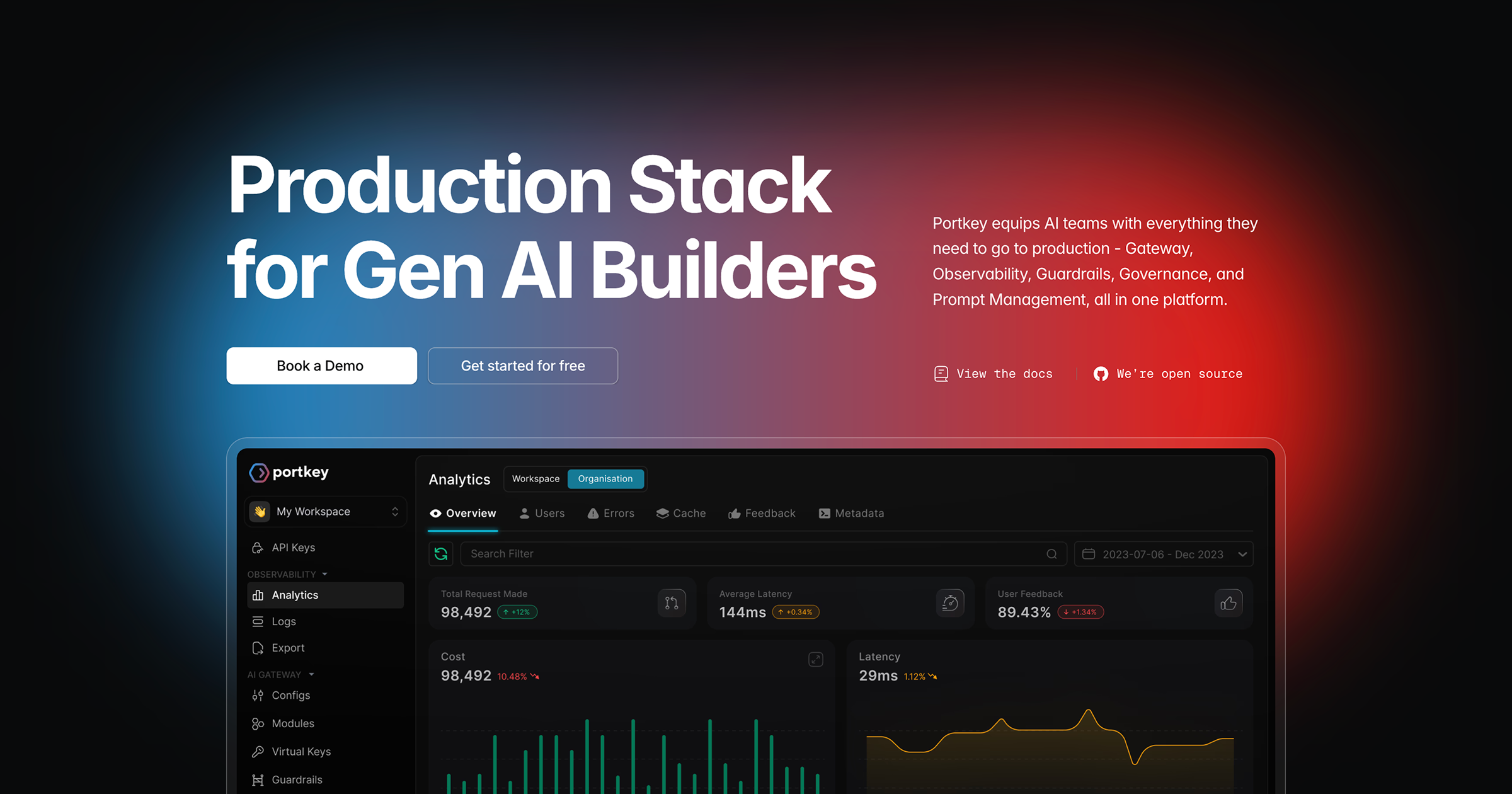
José Manuel Ortega's guide sends teams with formal requirements here, for its detailed logs, guardrails and per-team keys. It bills by logged requests, not a cut of your tokens, and its MIT-licensed gateway can be self-hosted. In Markaicode's test that gateway added about 4 ms per request against LiteLLM's 9 ms. Palo Alto Networks bought Portkey in May 2026 and is folding it into Prisma AIRS, and the open-source gateway has had no release since January.
- Pricing
- Production plan $49 a month, +$9 per extra 100k requests
- Free tier
- 10k logged requests a month; not meant for production
- Models
- 1,600+ LLMs
- Bring your own keys
- Yes; virtual keys with budgets
- Self-hosted
- Yes, the open-source gateway; private cloud on Enterprise
- Open source
- Gateway is MIT; 13,171 stars; last release January 12, 2026
Cortecs
A Vienna-based router that adds a flat 5% to provider prices and bills in euros. One Hacker News user switched to it from OpenRouter and limited the account to EU servers, giving up most US frontier models but keeping the Chinese open ones under GDPR. Another compared a DeepSeek model and found more than double OpenRouter's price with higher latency, so check your own model's page before you move.
- Pricing
- Pay as you go in EUR, by card or invoice
- Gateway fee
- Flat 5% on top of provider token rates
- Models
- 150+ models from 10+ EU providers
- Bring your own keys
- Yes
OpenCode Zen
A short list of models the OpenCode team has tested with coding agents, sold at cost through one key. It exists because one model can behave very differently from host to host, the problem Mo Moustafa documented across OpenRouter's providers. It works with other coding agents, not only OpenCode. The catalog is small by design, and card fees of 4.4% plus $0.30 are passed on with every top-up.
- Pricing
- Pay as you go per request, from prepaid credits
- Gateway fee
- Sold at cost; card fee of 4.4% + $0.30 per top-up passed on
- Free tier
- Some models free for a limited time; their data may be used
- Models
- Curated list: GPT, Claude, Gemini, Grok, Qwen and others
- Bring your own keys
- Yes, for OpenAI and Anthropic keys
Fireworks AI
Not a router but a single host for open models, which is what several developers suggest once an app is in production: one company and one set of quirks. A Hacker News user who ran open models here for a long time calls it a great provider that still had the odd issue. Mo Moustafa notes that on one DeepSeek model its tool-calling score fell to 46% in July 2026, so test your own workload.
Requesty
A hosted router close to OpenRouter in shape: one key, more than 600 models and a flat 5% on model cost. EU data residency comes on every plan, where OpenRouter keeps EU routing for its 8% Business plan. A Hacker News user says it let them pin providers and write their own routing policy. Independent accounts are still few, so run real traffic through the free tier before you commit.
- Pricing
- Pay as you go; no seats, no minimum spend
- Gateway fee
- 5% markup on model cost
- Free tier
- Free models only, 200 requests a day, no card
- Models
- 600+ models from 20+ providers
- Bring your own keys
- Yes, on pay as you go
Groq
Pick it when speed is the product. Markaicode's comparison, built on Artificial Analysis measurements, has it at roughly 473 tokens a second on GPT-OSS 120B against 142 for Together AI at the same price. The catalog is tiny and getting smaller, with four models cut in a year. The same review flags Nvidia's December 2025 licensing deal, which took Groq's founder and senior engineers, as a risk for anything load-bearing.
Together AI
A host with a wide catalog of open models plus fine-tuning, for when you want one supplier that carries most of what you used on OpenRouter. Markaicode counts more than 200 models. It is slower than Groq on the model both sell, and Mo Moustafa caught it returning empty replies on one DeepSeek checkpoint. There is no free trial: your first credit purchase must be at least $15.
EUrouter
An Amsterdam router that keeps your data in the EU and looks the most like OpenRouter of the European options. Two Hacker News users say they route their requests through it and that it works well. Price is the complaint: the free plan adds 15% to every token, and the markup only falls to 3% on the €99 a month plan. Two others in the same threads passed on it over cost.



How to choose
Match the pick to your reason for leaving. If it is the 5.5% fee on credits, Vercel AI Gateway charges no markup, and Cloudflare AI Gateway is free when you bring your own provider keys. If you want no middleman at all, self-host LiteLLM, or Bifrost if LiteLLM's latency bothers you. If your data must stay in Europe, look at Cortecs or Requesty. If you are tired of one model behaving differently from host to host, buy from a single host such as Fireworks AI, Together AI or Groq, or use OpenCode Zen's short tested list.
This market changed fast in 2026, so older guides are wrong in places. Stripe announced in August that it is buying OpenRouter. Palo Alto Networks bought Portkey in May. Helicone has been in maintenance mode since Mintlify bought it in March, and TensorZero's repository is archived, which is why neither is here. LiteLLM had two poisoned releases on PyPI in March (1.82.7 and 1.82.8), so pin your version. Self-hosting takes the gateway company out of the path, but your prompts still go to whichever model provider you call. And OpenRouter's fee is charged when you buy credits, with an $0.80 minimum, so small top-ups cost more than 5.5%.
The list is ordered by how many independent developers and reviewers recommend each option, then by adoption, then by price.
Prices checked October 11, 2026.
More guides like this
Claude Code Plugins (2026): What Developers Install
The best Claude Code plugins, picked from the setups developers publish after pruning their own installs and from Hacker News threads where people say what they kept, not from install counts alone. A plugin is a bundle. One install can carry skills, slash commands, subagents, hooks and MCP servers. A skill is a single instruction file Claude loads when it judges it relevant, and an MCP server is a connection to an outside tool, so a plugin can contain both. Type /plugin inside Claude Code to browse Anthropic's official marketplace, which is connected from the start, or run /plugin install name@claude-plugins-official. For anything else, add the maker's marketplace first with /plugin marketplace add owner/repo. If you install one thing, make it Superpowers, plus the LSP plugin for your language. Add Security Guidance if you ship code you don't read line by line, Plannotator if you want to mark up plans in a browser, and Claude HUD to see how full the context is. Every enabled plugin adds to the context on every turn, and several of the writers quoted here deleted more than they kept. Plugins run code on your machine with your permissions, and community marketplaces are not reviewed, so read what a plugin will install before you say yes. Two names trip people up. Claude Code has a built-in review command alongside the Code Review plugin. And Anthropic keeps a second, smaller marketplace in the anthropics/claude-code repo, where the loop plugin still goes by ralph-wiggum and not ralph-loop. The list is ordered by how many independent people recommend each plugin, then by installs and GitHub stars. Prices checked October 11, 2026.
Best Wispr Flow Alternatives (2026)
The best Wispr Flow alternatives: dictation apps that type into any app, for people leaving over price, cloud processing or platforms, picked from tests by 9to5Mac, ZDNet, Zapier and others. Leaving over price? Handy and FluidVoice are free, Chirp is $9.99 a year, VoiceInk is $25 once for a Mac, and Aqua Voice Pro is $8 a month billed yearly against Wispr Flow's $12. For privacy, Superwhisper, Handy, FluidVoice, VoiceInk, Spokenly and Chirp can transcribe without your audio leaving the computer, while Aqua and Typeless are cloud services like Wispr. On Linux, try Handy, Spokenly or Typeless. On Android, Typeless or Superwhisper. Accuracy depends on the model as much as the app: in Voice-list's test, Superwhisper's own models ranged from 1.6% to 22.8% of words wrong, so try another model before giving up on an app. Free tiers differ too. Aqua's is 1,000 words in total, Willow's free plan uses a lighter model, and Superwhisper's never runs out. Ordered by wins in named tests and how many independent reviewers recommend each app, then by how well it fixes the usual reasons for leaving Wispr Flow (price, privacy, platforms), then by price. Disclosure: Chirp is made by the team behind Listicle. We placed it ourselves, as the budget pick, and no independent reviewer has tested it yet. Everything else follows the order above. Prices checked October 5, 2026.
Best Clipboard Managers for Windows (2026)
The best clipboard managers for Windows 10 and 11, for anyone who has outgrown Win+V, ranked on hands-on tests by MakeUseOf, XDA, How-To Geek and others. Ordered by test wins and how many independent reviewers recommend each app, then by price, with Windows' own clipboard history included as the baseline. Pasta has no independent reviews yet, so it ranks below the apps that do. Win+V keeps 25 items and forgets them on restart unless you pin them. Ditto fixes both for free and won head-to-head tests at MakeUseOf and XDA. For more, CopyQ adds tabs and scripting, ClipClip adds an editor and OCR, and Pasteboard is the simplest modern-looking choice. Already using Raycast as a launcher? Its clipboard history is free and searchable. Most picks are free at home but not at work: ClipClip charges $49 for commercial use, ClipboardFusion's free version is for personal use only (Pro starts at $19 per PC), and Clipdiary's business license is $29.99. If you also use a Mac, Raycast and CopyQ run on both. Disclosure: Pasta is made by Automatique, the team behind Listicle; it's rated by the same criteria as everything else. Prices checked October 5, 2026.
Best Clipboard Managers for Mac (2026)
The best clipboard managers for Mac, from free apps to the history built into macOS Tahoe, ranked on hands-on tests by Zapier, MacStories, Six Colors and others. Ordered by test wins and how many independent reviewers recommend each app, then by price, with Spotlight's built-in history included as the free baseline. Pasta has no independent reviews yet, so it ranks below the apps that do. To choose, try Tahoe's Spotlight history first (Command-Space, then Command-4). If a week of history isn't enough, Maccy is the free step up, Paste is the one to get if your clipboard should follow you to an iPhone, and Pastebot suits people who reshape text as they paste. Already use Raycast, Alfred, LaunchBar or Keyboard Maestro? Try the history it already has before buying anything. Subscription or one payment? Paste costs $29.99 a year, while PastePal ($14.99), ClipBook ($9.99) and CopyClip 2 ($7.99) are one-time buys, and of those three only PastePal syncs with an iPhone. Pastebot sits in between: $39 up front, then $19 for each further year of updates. Disclosure: Pasta is made by Automatique, the team behind Listicle; it's rated by the same criteria as everything else. Prices checked October 5, 2026.
Best AI Task Managers (2026)
The best AI task managers, where the AI does real work from planning your day to running agents on a board, picked from hands-on tests by Wirecutter, PCMag, Zapier and others. Match it to how you work. If you want AI to plan your day, Sunsama walks you through a daily plan, Reclaim fits tasks around your meetings and has a free plan, and Motion plans and reshuffles your whole calendar. If you want a fast list with a little AI, start with Todoist. Teams should try Asana first, ClickUp if they want everything in one app, or Notion if their work already lives in docs. Software teams belong in Linear. On a budget: Todoist Pro and Reclaim Starter together come to about $15 a month billed yearly and put your Todoist tasks on your calendar, less than Motion's $19 alone. Google Gemini schedules tasks into Google Calendar for free. Watch the AI add-ons: ClickUp's Brain AI costs $9 a user on top of the plan, Notion's agents need the $20 Business plan, and Motion, Asana and monday.com meter AI with credits or request limits. Ordered by wins in named hands-on tests, then by how many independent reviewers recommend each app, then by fit for individuals and small teams and by price. Disclosure: Wand is made by Automatique, the team behind Listicle; it's rated by the same criteria as everything else. Prices checked October 5, 2026.
Best AI Story Writing Apps (2026)
The best AI story writing apps, from drafting partners like Sudowrite to manuscript critics like ProWritingAid, ranked on reviews by Kindlepreneur, Reedsy, The Write Practice and others. Match the tool to the job. To draft with an AI partner, Sudowrite works out of the box, while Novelcrafter gives you more control if you bring your own AI key. To revise, ProWritingAid catches line-level problems, Fictionary checks scene structure and Marlowe sends a whole-book report. For brainstorming or notes on a full draft, a general chatbot works: Claude for prose, ChatGPT for features, Gemini for very long manuscripts. On cost: Raptor Write is free and you pay only for the AI you use, and Gemini's Plus plan is $4.99 a month. Sudowrite's Hobby plan and ProWritingAid Premium together come to about $20 a month on yearly billing. Most of these meter AI use in credits or tokens, so heavy drafting can cost more than the plan price. Ordered by how many independent reviewers tested or recommended each app, then by how well it suits writing your own fiction, then by price. Disclosure: Fable is made by Automatique, the team behind Listicle; it's rated by the same criteria as everything else. Prices checked October 5, 2026.