Best AI Harnesses (2026)
 By @pickwise
The best AI harness can matter as much as the model. On one model, Claude Sonnet 4.6, AIMultiple scored harnesses from 43% to 82%. These picks rest on same-model tests by AIMultiple, Composio, Tensorlake and Claw-SWE-Bench.
What we track: Same-model tests · Cost in tests · Models · License · GitHub stars
- Same-model tests:
- Where it placed in tests that ran several harnesses on the same model, so the score reflects the harness, not the model.
- Cost in tests:
- How cheap it was per task or per solved task in those same-model tests, cheapest first. The model sets the price per token; the harness sets how many tokens a job takes.
- Models:
- Which models it can run: any provider, or one company's models only.
- License:
- Open source, source-available or closed. Open source means you can read, fork and self-host it.
- GitHub stars:
- How many developers starred the repository, a rough sign of how widely it is used.
These numbers inform the order but don’t set it: an editor ranks the picks, weighing them against what people who use them say, since stars and downloads also reflect hype and marketing.
A general agent first: Hermes remembers across sessions, writes its own skills and answers on Telegram, Slack or Discord, with coding one job among many. Even so, it resolved the most GitHub issues of seven harnesses in Claw-SWE-Bench, with each of three models, and came third of eight in Composio's Kimi K3 test at the lowest cost. Shrijal of Composio warns it has no operating-system sandbox by default, so run it in Docker.
- Same-model tests 1st of 7, Claw-SWE-Bench; 3rd of 8, Composio (Kimi K3)
- Cost in tests Cheapest of 8 at Composio ($0.46/success); 3rd–6th of 7, Claw-SWE-Bench
- Models Any provider, incl. Nous Portal, OpenRouter, OpenAI, your own endpoint
- License MIT
- GitHub stars 256,862
Topped AIMultiple's test of eleven terminal harnesses on Claude Sonnet 4.6 at 81.6%, and was the cheapest capable one at $1.03 a task. Results don't travel, though. Tensorlake ran four harnesses on DeepSeek V4 Flash and OpenCode came last, and AIMultiple found it kept none of 13 facts after compacting its context. Both tests predate OpenCode 2. In October 2026, attackers reached provider keys saved in OpenCode Console, though not the app itself.
- Same-model tests 1st of 11, AIMultiple (Sonnet 4.6); 4th of 4, Tensorlake
- Cost in tests 3rd cheapest of 11, AIMultiple; 2nd of 4, Tensorlake; 7th of 8, Composio
- Models 75+ LLM providers, including local models
- License MIT
- GitHub stars 221,252
- 3
Pi
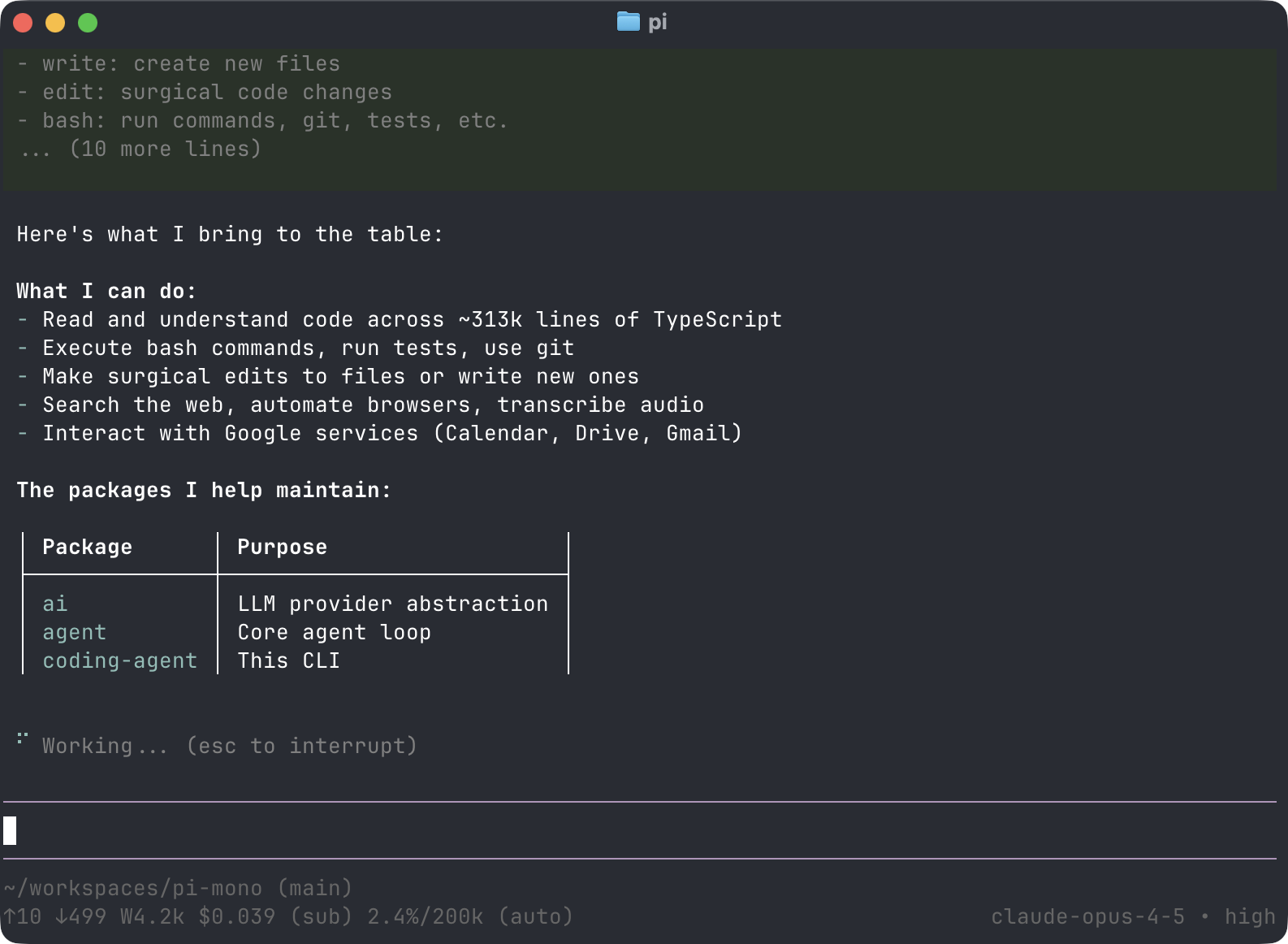
Pi ships four tools (read, write, edit and bash) and little else, and that lean loop won Tensorlake's same-model test: 20 of 30 tasks on DeepSeek V4 Flash, ahead of Claude Code, Codex and OpenCode, for $0.56 in all. OpenBench and Composio also clocked it fastest. The flip side, noted by both Tensorlake and Composio, is no permission boundary: the agent has full access to your machine from the first message.
- Same-model tests 1st of 4, Tensorlake; tied 5th of 8, Composio
- Cost in tests Cheapest of 4 at Tensorlake ($0.028/success); 3rd of 8, Composio
- Models 15+ providers, including OpenRouter and local models through Ollama
- License MIT
- GitHub stars 117,647
A fork of Pi with sub-agents, language-server tools and more than 60 providers built in, and the winner of Composio's eight-harness test on Kimi K3, passing 22 of 25 tasks. Those were business-app jobs in Gmail, Slack and GitHub, not coding. Hacker News user jeremyjh runs it on stock settings because there is nothing to add. In the same test Pi and Hermes Agent finished faster, and dom96 still finds it unpolished.
- Same-model tests 1st of 8, Composio (Kimi K3)
- Cost in tests 2nd cheapest of 8 at Composio ($0.52/success)
- Models 60+ providers
- License MIT
- GitHub stars 36,494
Cursor's agent runs in its editor and in the terminal as Cursor CLI. The editor topped AIMultiple's test of six AI code editors on Claude Opus 4.6, with the best backend and combined scores, and the testers say it consistently applies the smallest viable fix. Hacker News user christophilus got a far better app design from Cursor CLI than from Codex. It is closed source, that test ran Cursor 2.5 in February, and usage comes from weekly allowances.
- Same-model tests 1st of 6 editors, AIMultiple (Opus 4.6)
- Cost in tests $27.90 of usage in AIMultiple's run, covered by a $20 plan
- Models Composer plus Anthropic, OpenAI, Gemini and xAI models
- License Closed source
- GitHub stars Closed source
It reached the top three in two same-model tests: third of eleven on Sonnet 4.6 for AIMultiple, and tied second with Codex on DeepSeek V4 Flash for Tensorlake, which calls it the best daily driver. With Opus 5.5 it also leads the Terminal-Bench 2.0 leaderboard at 64.85%. It costs the most to run: $3.12 against Pi's $0.56 at Tensorlake. It is closed source and built for Claude models.
Tensorlake rates Codex the safest harness, because an operating-system sandbox keeps writes in the workspace with the network off. On DeepSeek V4 Flash it tied Claude Code at 16 of 30 tasks for less than half the cost, though its median run took about twice as long. Other tests were harder on it, partly through setup: AIMultiple had to reach Sonnet 4.6 through a proxy, and Composio's Kimi K3 run put it last of eight.
- Same-model tests Tied 2nd of 4, Tensorlake; 8th of 11, AIMultiple (proxy)
- Cost in tests 4th cheapest of 11, AIMultiple; 3rd of 4, Tensorlake; tied 5th of 8, Composio
- Models GPT-6.1 Sol and GPT-6 Luna on Plus; API key models otherwise
- License Apache-2.0 (the client)
- GitHub stars 130,824
A personal assistant first: OpenClaw answers in more than 20 chat apps and treats models, and even harnesses such as Claude Code and Codex, as plugins. Coding is one job among many, yet in Claw-SWE-Bench it resolved the second-most issues with each of three models, just behind Hermes Agent. The risk is its skill store. Unit 42 found malicious ClawHub skills that passed the store's scanners as late as May 2026, and skills run with the agent's own access.
- Same-model tests 2nd of 7, Claw-SWE-Bench (all three models)
- Cost in tests 3rd–5th cheapest of 7, Claw-SWE-Bench, across three models
- Models Hosted and local providers; Claude Code and Codex as plugins
- License MIT
- GitHub stars 392,976
Google's agent-first IDE and its terminal twin, Antigravity CLI, which replaced Gemini CLI. The IDE came third of six in AIMultiple's Claude Opus 4.6 editor test, strong on backend tasks, and MerginIT's October tier list puts the CLI with Gemini 4 Argon second on Artificial Analysis's coding index. Jessica Wachtel at The New Stack found the CLI edits files headless where Gemini CLI could not. It is closed source, and its free weekly quota runs out fast.
- Same-model tests 3rd of 6 editors, AIMultiple (Opus 4.6)
- Cost in tests Free in preview during AIMultiple's editor test
- Models Gemini 4 Argon and Flash, Claude Sonnet and Opus 5.5, GPT-OSS 120B
- License Closed source
- GitHub stars Closed source
xAI's terminal agent, open source under Apache-2.0 since July 2026, came second of eleven in AIMultiple's Sonnet 4.6 test at 80.3%, about a point behind OpenCode. Composio's Kimi K3 run was less kind: mid-table, with more tool calls than any other harness. The bigger catch is usage. Hacker News user jmaker used up a week of SuperGrok after 20 to 30 simple prompts, and nwienert, on the $300 plan, runs out on the first day of each week.
- Same-model tests 2nd of 11, AIMultiple (Sonnet 4.6); tied 5th of 8, Composio
- Cost in tests 9th cheapest of 11, AIMultiple; tied 5th of 8, Composio
- Models Grok models; custom models through config.toml
- License Apache-2.0
- GitHub stars 27,534
- 11
goose
The pick when you want no single company in charge: goose is Apache-2.0, started at Block and now sits with the Agentic AI Foundation, with a CLI and a desktop app. Benchmarks are its weak spot. AIMultiple's Sonnet 4.6 run gave it the lowest of nine clean scores, 62.5%, at the second-highest cost, $3.23 a task. Attila Macskásy got about 2,400 lines of correct code from it, then watched it loop for two hours on a vaguer task.
- Same-model tests 10th of 11, AIMultiple (Sonnet 4.6)
- Cost in tests 10th cheapest of 11, AIMultiple ($3.23 a task)
- Models 15+ providers, including Ollama and OpenRouter
- License Apache-2.0
- GitHub stars 55,665
Cline's terminal version runs the same agent as its VS Code extension and asks before each edit or command unless you turn on auto-approve. In AIMultiple's Sonnet 4.6 test it ranked fourth on backend work but had the weakest frontend, with four tasks cut short by its error limit, for 64.4% overall. ITProTutorials called its Docker Compose refactor production-ready. A stolen npm token pushed a rogue release in February, so pin your version.
- Same-model tests 9th of 11, AIMultiple (Sonnet 4.6)
- Cost in tests 5th cheapest of 11, AIMultiple ($1.62 a task)
- Models Anthropic, OpenAI, Gemini, OpenRouter, Bedrock, any OpenAI-compatible
- License Apache-2.0
- GitHub stars 70,838
- 13
Crush
None of the same-model tests here included Crush, so it rests on reviews. Joe Rice-Jones at XDA says it pulled in his Claude Code config and shows the API cost of each step in the sidebar, and Jakub Jirák finds its polish ahead of its battle-testing. It is a single Go program that switches models mid-session. You can't sign in with a Claude, ChatGPT or Gemini plan, and its FSL licence is source-available, not open source.
- Same-model tests Not in AIMultiple, Tensorlake, Composio or Claw-SWE-Bench
- Cost in tests Not in these tests
- Models Many providers plus any OpenAI- or Anthropic-compatible API; Ollama
- License FSL-1.1-MIT, source-available, not open source
- GitHub stars 28,801
DeepSeek's MIT-licensed agent makes every part, down to the loop itself, a plugin you can swap, and it opens in a browser or desktop app. In Claw-SWE-Bench it finished fourth of seven with each of three models, five points behind Hermes Agent on DeepSeek's own V4.1 Flash. DeepakNess calls its session timeline the most transparent agent UI he has used, but his npx install failed, and it is still a developer preview.
- Same-model tests 4th of 7, Claw-SWE-Bench (all three models)
- Cost in tests 4th–6th cheapest of 7, Claw-SWE-Bench, across three models
- Models DeepSeek and most major providers, plus any OpenAI-compatible API
- License MIT
- GitHub stars 260,722
- 15
Aider
The oldest harness here and the easiest to undo, since every edit becomes a git commit you can revert. On a local Qwen model, kenimo49 saw it finish all twelve of his tasks with the smallest prompt of three agents. On Sonnet 4.6 in AIMultiple's test it came last of eleven at 43.2%, and it doesn't browse the web. The bigger catch is upkeep: the repository has had no commits since May 22, 2026.
- Same-model tests 11th of 11, AIMultiple (Sonnet 4.6)
- Cost in tests 2nd cheapest of 11, AIMultiple ($0.47 a task), lowest score
- Models Almost any LLM, including local models
- License Apache-2.0
- GitHub stars 49,742


How to choose
An AI harness is everything around the model: the agent loop, tools, context management, system prompt and interface. Agent harness, coding harness and AI coding agent are other names for it. Harness (harness.io) is something else, a DevOps company.
For coding with any model, start with OpenCode or Pi, or oh-my-pi for Pi with the extras built in. For one agent that codes, remembers and answers on Telegram or Slack, Hermes Agent, or OpenClaw for more chat apps. If you already pay for Claude or ChatGPT, Claude Code and Codex CLI use those plans. Cursor and Antigravity have free tiers and an editor. Codex is the safest out of the box. Every pick except Cursor, Claude Code, Antigravity and Crush is open source.
What the makers won't tell you. Rankings don't travel: OpenCode topped AIMultiple's test and came last in Tensorlake's, and most tests ran older versions. The harness also sets the bill: on the same model at Tensorlake, Pi cost about 3 cents a solved task and Claude Code 19 cents. Claude Code is built for Claude models. Grok Build's SuperGrok allowance runs out fast. In October 2026 attackers reached provider keys saved in OpenCode Console; revoke saved keys at the provider. Gemini CLI stopped serving personal accounts on June 18, 2026, and Antigravity CLI replaced it. Crush is source-available, not open source. Pi, oh-my-pi and Hermes Agent have no sandbox by default, and OpenClaw's skill store has carried malware.
Ordered by wins in named tests that hold the model fixed, then other top-three finishes in them, then independent recommendations, then GitHub stars. Aider, with no commits since May 22, 2026, sits below the rest.
Prices checked October 24, 2026.
Pick a model for your harness
A harness is only the loop around a model, so you still need one. A flat monthly plan that works in several harnesses is in AI coding plans. To run the model on your own machine, see local LLMs for coding.
Extend the harness you picked
Most harnesses take add-ons. See Pi extensions, Claude Code plugins and OpenClaw skills. If you are leaving OpenCode, OpenCode alternatives compares the agents people moved to.
How to install an AI harness
Every pick but Cursor and the Antigravity IDE installs from a terminal with the command on its card. Most use a one-line script (curl -fsSL … | bash). Cline and Crush install with npm, which needs Node.js, and DeepSeek Harness runs with npx @deepseek-ai/dsh web.
Then point it at a model. Claude Code (claude) and Codex (codex) sign in with a Claude or ChatGPT plan. OpenCode (opencode, then /connect), Pi (pi, then /login), Hermes Agent (hermes model) and goose (goose configure) take a provider API key, a coding plan or a local model through Ollama.
Run the agent inside your project folder. Pi, oh-my-pi and Hermes Agent have no sandbox by default, so start them in a container or a VM if the code isn't yours.
More guides like this
Best OpenCode Alternatives (2026)
The best OpenCode alternatives are the terminal coding agents developers say they moved to in blog posts and Hacker News threads, checked against independent hands-on reviews. If OpenCode feels bloated, get Pi, or oh-my-pi if you want Pi with the tools already built in. If you want one vendor's best models at a flat monthly price, get Claude Code or Codex CLI. That is the real OpenCode vs Claude Code difference: Claude Code runs only Claude models, OpenCode any provider. Codex sandboxes commands by default. For open source with any model and no single company in charge, get goose. For the nicest terminal interface, Crush. For an agent that asks before every edit, Cline CLI. To pay nothing for models, Freebuff, which shows ads. For a desktop app that runs any model, DeepSeek Harness. If you pay for GitHub Copilot, its CLI is included. OpenCode Go, the $10 model plan, also works in Pi, Claude Code and Codex. What the makers' pages won't tell you. On October 17, 2026 attackers broke into an older OpenCode system and reached provider keys saved in OpenCode Console, affecting 1.4% of Console users. TechCrunch reports charges above $1,000 on some accounts, and OpenCode's co-founder says the app and CLI were not affected. Revoke a saved key at the provider: deleting it in OpenCode doesn't stop a stolen copy. OpenCode 2 has a new plugin API, so OpenCode 1 plugins don't run on it. Crush grew out of an older Go project also called OpenCode, and its license is source-available, not open source. Gemini CLI stopped serving personal accounts on June 18, 2026; Antigravity CLI replaced it. Aider has had no commits since May 22, 2026. Kilo CLI is built on OpenCode, so switching to it changes little. A free agent still needs a model: you pay a provider per token or run one yourself. The list is ordered by how many independent developers and reviewers recommend each agent, then by GitHub stars, then by price. Prices checked October 24, 2026.
Best AI Coding Plans (2026)
The best AI coding plans give your coding agent a month of strong models for a flat fee, often a tenth of Claude Max. These picks rest on hands-on reviews by KDnuggets, Bitdoze, Tony Reviews Things and Hacker News developers. For the most models for the least money, start with OpenCode Go at $10 a month. For one strong open model all day, the GLM Coding Plan or MiniMax's M Plan. For open models with zero data retention, Ollama Cloud. If you already pay for ChatGPT, Codex is included, and the same plan now signs in to OpenCode, Pi and Kilo Code. To reach Claude and GPT models from OpenCode for $10, GitHub Copilot Pro. The cheapest coding plans are Xiaomi MiMo at $6, Alibaba's Qwen Token Plan at $8 and Synthetic at $9. The open-model plans here also run inside Claude Code through an Anthropic-compatible endpoint. GLM vs Kimi vs MiniMax coding plan: in an April head-to-head in the Pi agent by Lotus Creation Concepts, GLM gave the best result and MiniMax ran fastest, and Reddit users say Kimi K3 burns its quota quickest. What the makers' pages won't tell you. Most of these plans changed in 2026. Z.ai moved the GLM plan to credits, and the quota works only in the tools it lists. MiniMax replaced its Token Plan with M Plan, whose text model is M3.1 Flash. Anthropic covers OpenCode, Pi and other agents only through a separate monthly credit billed at API rates. Copilot meters chat and agent work in AI credits. OpenCode Go, Ollama Cloud and Copilot give a dollar allowance at token prices, so a flagship like Kimi K3 drains it fastest. Z.ai's and Alibaba's discounted hours fall in the American daytime. Ordered by how many named hands-on reviews back each plan, then by how many developers recommend it on Hacker News and Reddit, then by price, lowest first. Prices checked October 24, 2026.
Best OpenClaw Skills (2026): Safe Picks From ClawHub
The OpenClaw skills worth installing, for email, code, notes and browsing, each checked against its source and its ClawHub security audit. For email and calendar, start with Gog. For code, GitHub. For long articles, videos and podcasts, Summarize. For notes, Obsidian or Notion. To stop the agent repeating a mistake, self-improving agent. For cleaner prose, Humanizer. Safety first. ClawHub, the registry, lets anyone with a GitHub account publish, and a skill acts with whatever access your agent has. Security firms have counted more than a thousand malicious skills there since January 2026, and in June Unit 42 and Trail of Bits each showed skills getting past its scanners. OpenClaw's own June data labelled 25,504 of 67,453 skill versions suspicious and 206 malicious. Every skill page now has a security audit with an outcome such as Pass or Review. Read it, and the SKILL.md, before you install. Older guides are out of date in three ways. Most of the skills they tell you to install now ship with OpenClaw and switch on when their command-line tool is present. Web search, self-learning and memory search are built in, and Tavily has a first-party plugin, so the Tavily and QMD skills are no longer needed. And names are copied: at least five publishers use the slug gog, so install with the owner, as in @steipete/gog. Capability Evolver is on most lists and left out here: ClawHub's audit marks it for review because it can run jobs handed to it by a remote server. Skills are ordered by how many independent reviewers and users recommend them, then by downloads or stars. All are free. Numbers checked October 18, 2026.
Pi Extensions (2026): Best Add-ons for the Pi Coding Agent
The best Pi extensions for subagents, web search, plan mode and permissions, picked from the setups developers publish, each with its pi install command. Pi is deliberately bare: no sub-agents, no plan mode, no permission prompts. You add what you miss with one command, pi install npm:<package>. If you are starting out, three cover most of the gap with Claude Code: pi-subagents for delegation, pi-web-access for search, and rpiv-ask-user-question so the model asks before it guesses. Add Plannotator if you want plan mode, and pi-permission-system or pi-landstrip if you don't want the agent free to run anything. Three things have changed that older guides miss. Pi 1.0 shipped on October 1, 2026, and every pick here has had a release since except context-mode and pi-simplify, which we couldn't confirm on 1.x. Pi has had MCP support built in since version 0.99, so pi-mcp-adapter is now an upgrade and no longer a requirement. And several popular names have lookalikes: npm has at least four other packages named pi-mcp-adapter under other people's scopes, and more than one /btw and /simplify extension, so install by the exact name shown here. Extensions run with the same access to your machine that Pi has. Pi's catalog lists more than 5,000 packages, so read the source of anything that touches your shell or credentials, and pin versions you depend on. Ordered by how many independent users and reviewers recommend each one (Kay Rhodes's setup guide, Composio's tested top ten, XDA's hands-on, developers on Hacker News and Pi's own GitHub discussions), then by npm downloads and GitHub stars. Downloads count automated installs too, so treat them as a rough signal. Numbers checked October 24, 2026.
Claude Code Plugins (2026): What Developers Install
The best Claude Code plugins are Superpowers, a language server plugin for your language and Frontend Design, judged by the setups developers publish after pruning their installs and by what Hacker News users say they kept. A plugin is a bundle. One install can carry skills, slash commands, subagents, hooks and MCP servers. A skill is a single instruction file Claude loads when it judges it relevant, and an MCP server is a connection to an outside tool, so a plugin can contain both. If you install one thing, make it Superpowers, plus the LSP plugin for your language. Add Security Guidance if you ship code you don't read line by line, Plannotator if you want to mark up plans in a browser, and Claude HUD to see how full the context is. For web work, Frontend Design shapes the look, and Playwright or Chrome DevTools MCP lets Claude check the page in a real browser. Every enabled plugin adds to the context on every turn, and several of the writers quoted here deleted more than they kept. Token savers promise more than they deliver: a JetBrains test cut Caveman's advertised 65% to 8.5%. Plugins run code on your machine with your permissions, and Anthropic doesn't review third-party marketplaces, so read what a plugin will install before you say yes. Two names trip people up. Claude Code has a built-in review command alongside the Code Review plugin. And Anthropic's claude-security plugin, in beta, is a whole-repository scan, separate from Security Guidance. The list is ordered by how many independent people recommend each plugin, then by installs and GitHub stars. Numbers checked October 24, 2026.
Best Local LLMs for Coding (2026)
The best local LLM for coding depends on how much memory your machine has. This list ranks open-weight models you can run yourself, by independent benchmark runs and by developers who use them in coding agents. With 24 to 32 GB, start with Qwen3.8-27B. Its 17 GB 4-bit file matched the full model on Terminal-Bench 2.1 in Quesma's test. With 128 GB of unified memory, Qwen3.8-Flash-Next posted the top score in WonderRico's benchmark. With 16 GB, gpt-oss-20b fits whole on the card, and one developer reports useful work from a 2-bit Qwen3.8-27B. With 8 GB, try Qwen3.5-9B and keep the jobs small. At 64 GB, run the 27B models at 8-bit, a 29 GB file, with a longer context. The step above that needs about 100 GB. A coding agent only works if the model emits tool calls your server can parse. Gemma 4 shipped with broken tool calling that was fixed later, and Qwen chat templates have needed community fixes, so update Ollama, LM Studio or llama.cpp before blaming the model. Agents also need room: LM Studio loads models with an 8,192-token context unless you raise it. Scores on a model card are the maker's own. A mixture-of-experts model computes with a few billion parameters per token but still has to hold all of them in memory, and context takes memory on top of the file. Qwen3.8 thinks at its highest effort by default, which is slow on home hardware. Qwen3.8-Flash-Next is not Apache licensed. Older guides still recommend Qwen2.5-Coder, Qwen3-Coder and Devstral, which general-purpose models beat in the hands-on tests cited here. The list is ordered by how many independent testers and developers recommend each model for coding, then by downloads. Numbers checked October 11, 2026.